


Webinar With Me - Canada's Dark History
- Oct 29, 2022
- 5 min read
Updated: Sep 27, 2023
What would it look like if we took the sins of colonialism seriously?
On a Saturday afternoon in late October, I had the pleasure of attending one of the Outreach Conference workshops organized by the Anglican Church of Canada.
Having never sat in on one before, I didn’t know what to expect but was very pleasantly surprised at the transparency held in the space and the degree to which I learned more about Indigenous history in the short hour and 15 minutes.
I’d like to include you in the event by sharing my report with you in hopes that these topics will reach more people.
Along with 25 attendees, “The Housing Crisis, Encampments, and the Legacy of Indian Residential Schools” was hosted by Sandra Cambell, the Indigenous Outreach Coordinator at the Toronto Urban Native Ministry (servicing Indigenous people across the GTA), and Leigh Kern, the Right Relations Coordinator for the Diocese of Toronto. I must add that both of these individuals possess powerful truth-telling skills and an inspiring ability to share resources / exchange information in a meaningful way. Throughout the presentation, they continued to acknowledge and take ownership for the contributions that the Anglican Church made in support of residential schools & for the violence Christianity protected.
Content warning: the following information involves dark subjects that may be sad & disturbing to some people. I will be discussing themes like:
The architecture of genocide
The colonial violence which made modern Canadian society possible
The criminalization of people who are poor
Residential schools & those who never returned home from them
If any of these topics feel triggering to you, please take caution when reading past this point.
We started with a 10 minute prayer that guided us through reminders about the collective & individual spiritual journeys which ground us to the world in unsaid & unseen ways.
A land acknowledgement followed this, including the meaning and significance of tribal names and the positive contributions Indigenous tribes made to and with nearby treaties. Kern went on to reveal some of the manipulative tactics that British colonizers used to promote settlement, like their attack and demonization of Indigenous migration despite their own previous lifestyle involving encampment. Despite the superimposition of British towns, these Indigenous tribes are still here in Toronto today.

The speakers then discussed the importance of kinship, strong relationships, and family in Indigenous life. The inclusions of animals and land in the meaning of “family” is natural and inevitable for them- it goes without saying. All of these principles of home, kinship, and family were spiritual values before they became a materialized concept. Before colonization, information was naturally exchanged between nations and communities without ulterior motive as a result of this free and nurturing spirit.
Such values- friendship, family, trust, knowledge, kinship- contrasted the principles that guided residential schools. Colonization was (and continues to be) about building an economy through resource extraction. Colonial rule was a power grab between empires, a man-made competition for who could extract the most value from resources and free labor the fastest. For example, the ancient white pines pictured in the painting above that made up Toronto in 1803 ended up being used to build ships that would transport enslaved people, who were then used as pawns to make profit for the empire.
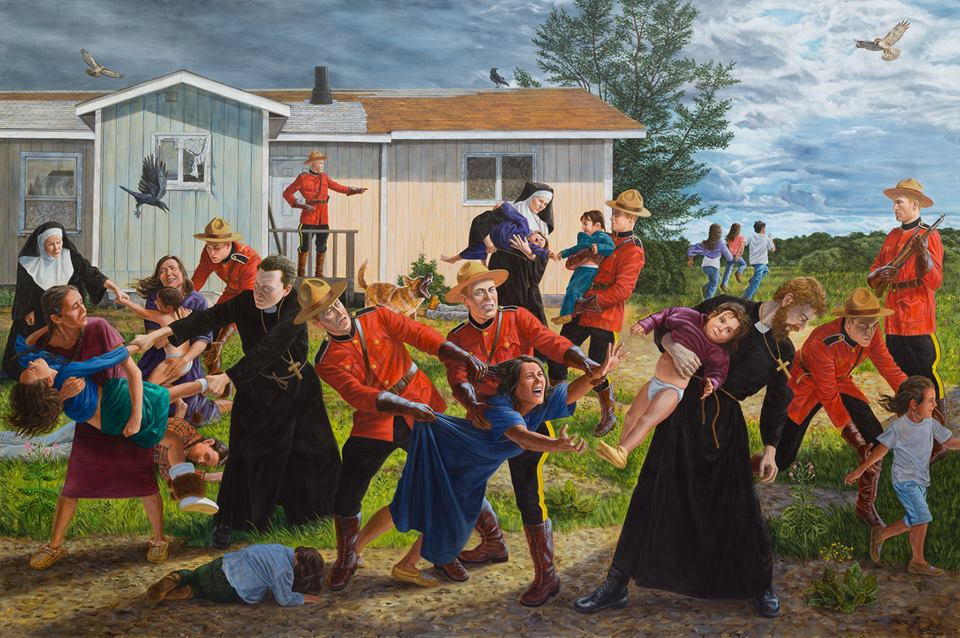
Residential schools were not schools at all in the sense that there was no education or knowledge being taught. Indigenous children were tasked to do free labour in these Anglican-run institutions, which were notorious for sexual violence and abuse. These “schools” were strategically placed far from the original homes of Indigenous children so that escaping students wouldn’t be able to recognize the land around them when they tried to run away. A compelling quote I grabbed from this segment of the webinar taken from an Ingenious account around that time was “No white parent would ever put up with this form of education”. In 1920 the Indian Act made residential schools mandatory.
Since Indigenous Peoples live with the land and consider it a part of their family, the concept of private property (another invention of colonization to drive capital profit) did not agree with their values or lifestyle. This, along with the shelter system being very triggering to the environment of residential schools, is one of the major reasons why so many Indigenous Peoples are homeless today. Though, they feel like “houseless” is a more suitable term considering they “can’t be homeless if they are living on their own land”. More often than not, they are now ticketed and sometimes even criminalized for camping in Toronto’s parks. When they try to make the case that this is their land and they’re entitled to camp on it, police respond by escorting them off the property and telling them it’s “the Queens land and they’ve overstayed their welcome”.
More of these first hand reports and material about the lived experiences of Indigenous Peoples in Toronto can be found in the upcoming book “Displacement City: Fighting for Homes and Health in a Pandemic” edited by Greg Cook and Cathy Crowe (book launch at Holy Trinity on November 9th, 12pm).
The presenters of this webinar did an amazing job describing the impact that colonialism has had on ideas of kinship, home, & family, while also providing the historical context of what this means. By asking questions like “How is the church responsible for the violation of Indigenous dignity and rights today?” I believe they’re starting in the right place when working towards truth & reconciliation.
I understand how depressing it can feel to realize that your own Canadian life was manifested by a violence and destruction aimed towards innocent people, and I relate to that feeling often. Recently Canadian history has made me feel like communities built on love, kindness, and respect are bound to be overthrown by evil, considering that the very values of any competing group are founded on a willingness to manipulate and violate others and therefore will enviably possess a stronger physical power over that of the innocent group. How can we not deduct that large societal groups have a natural progression to discrimination, then?
The difference between the two groups is that one will always be bound to inner peace and the other to inner war. One is guided by an undying light- that of love and compassion- and the other guided by darkness- that of money and power. Morality has an unseen power that I wish to believe colonial rule could never understand or touch - and I think this is important to keep in mind.
Here are some ways you can get involved:
The second Tuesday of each month a homeless memorial is hosted at Holy Trinity around 12pm
Join the rally for National Housing Day on November 22nd 2022 11:45 am at David Crombie Park
Don’t support politicians who won’t advocate for affordable housing
If you have come this far - thank you for reading. I hope you were reminded of some important truths. Personally, I can’t think of a better way to spend my Saturday afternoon.


Comments